Garlic Mustard
Alliaria petiolata
[officinalis]
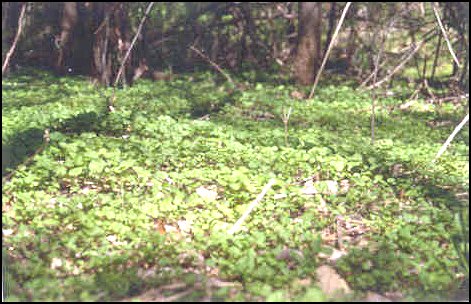
Garlic mustard threatens native plants
and animals
From the Michigan State University Crop Advisory Team Alert,
Landscape Edition, Vol
16, No.6, May 18, 2001
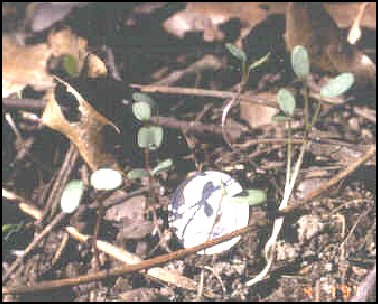
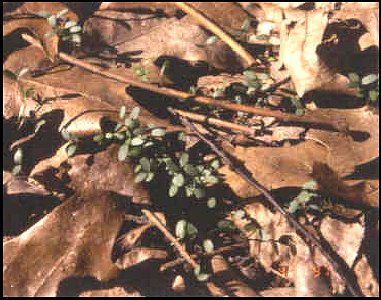
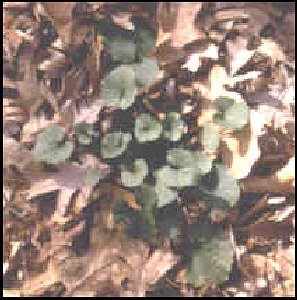
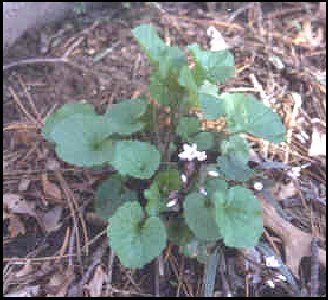
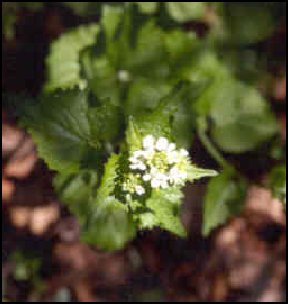
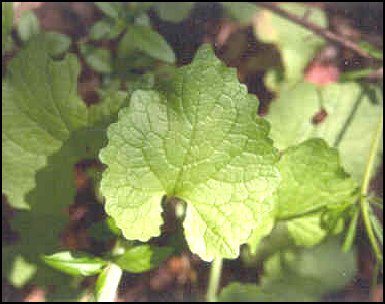
Garlic mustard (Alliaria petiolata) is a cool season biennial herb in the mustard family (Brassicaceae) with stalked, triangular to heart-shaped, coarsely toothed leaves that give of an odor of garlic when crushed. First-year plants appear as a rosette of green leaves close to the ground. Rosettes remain green through the winter and develop into mature flowering plants in the following spring. Flowering plants of garlic mustard reach from 2 to 3.5 feet in height and produce button-like clusters of small white flowers, each with four petals in the shape of a cross.
By late May, seeds are produced in erect, slender pods and become shiny black when mature. By July, when most garlic mustard plants have died, they can be recognized only by the erect stalks of dry, pale brown seedpods that remain and may hold viable seed, through the summer. A single plant can produce thousands of seeds, which scatter as much as several meters from the parent plant. Depending upon conditions, garlic mustard flowers either self-fertilize or are cross-pollinated by a variety of insects.
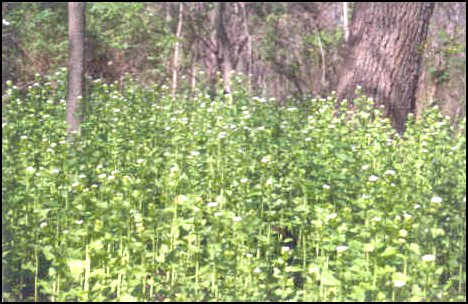
Garlic mustard poses a severe threat to native plants and animals in forest communities. Many native wildflowers that complete their life cycles in the springtime (e.g., spring beauty, wild ginger, bloodroot, Dutchman's breeches, hepatica, toothworts, and trilliums) occur in the same habitat as garlic mustard. Garlic mustard is simply more aggressive and takes over these wildflower communities.
Current management approaches
Garlic mustard seeds can live for five years or more. Effective management of garlic mustard requires a long-term commitment. The goal is to prevent seed production until the stored seed is exhausted. Hand removal of plants is possible for light infestations and when desirable native species co-occur. Care must be taken to remove the plant with its entire root system because new plants can sprout from root fragments. This is best achieved while plants are small and the soil is moist, by grasping the base of the plant firmly and tugging slowly and gently until the main root loosens from the soil and sthe entire plant pulls out. Pulled plants can be left onsite or removed.
For larger infestations, flowering stems can be cut at ground level or within several inches of the ground to prevent seed production. If stems are cut too high, the plant may produce additional flowers at leaf axils. Once seedpods are present, but before the seeds have matured or scattered, the stalks can be clipped, bagged and removed from the site. This can be done throughout much of the summer.
For very heavy infestations, where the risk to desirable plant species is minimal, application of the system herbicide glyphosate (e.g., Roundup) is effective. Herbicide may be applied any time the temperature is above 50° F and rain is not expected for about eight hours. Extreme care must be taken not to get glyphosate on desirable plants, as the product is non-selective and will kill any plant it contacts. Spray shields may be used to better direct herbicide and limit non-intentional drift. (Note to Michigan readers: fall applications to the rosette stage of the plant may be most effective.)
Internet options for more information
NPCI Alien Plant Working Group – Garlic Mustard http://www.nps.gov/plants/alien/fact/alpe1.htm
Cornell University, Biological Control of Weeds—Garlic Mustard http://www.dnr.cornell.edu/bcontrol/garlic.htm
Tennessee Exotic Pest Plant Council http://www.webriver.com/tn-eppc/species/alipet.htm
Virginia Natural Heritage Program Fact Sheet—Garlic Mustard http://www.state.va.us/~dcr/dnh/invallia.htm
 Michigan Invasive Plant
Council Home Page
Michigan State University programs and materials are open to all without regard to race, color, national origin, gender, religion, age, disability, political beliefs, sexual orientation, marital status, or family status.
Questions about MSU Agriculture & Natural Resources websites? Contact ANR Computer Services
CANR Web Server IIA Web Server MAES Web Server MSUE Web Server MSU Web Server